The Right Google Business Profile Category for Sound Healing, Reiki, Ayurveda, and Lymphatic Drainage
The short answer
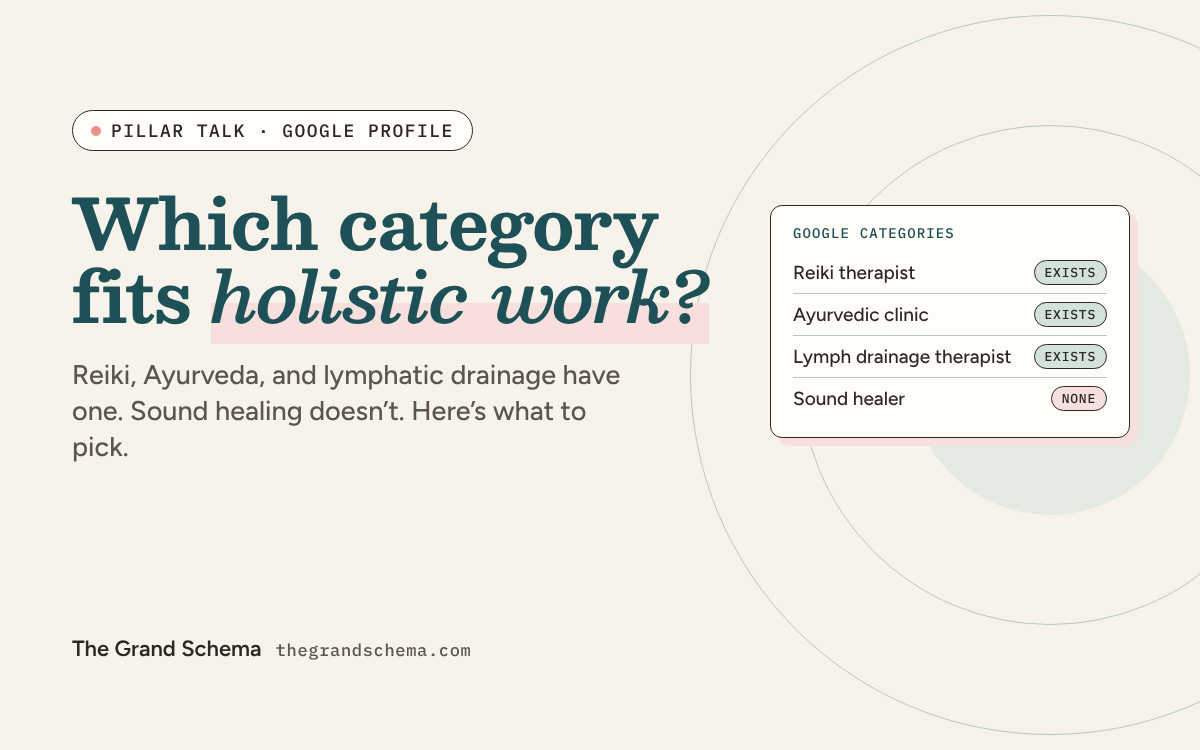
Google has roughly 4,000 business categories, and more holistic work has one than practitioners expect. Reiki therapist, Ayurvedic clinic, Lymph drainage therapist, Herbalist, Craniosacral therapy, Reflexologist, and Acupuncturist all exist. Sound healing and breathwork don’t. Pick the most specific category that’s true of your whole practice, add the others as secondary categories, and carry the words Google has no category for in your services, your description, and your own website.
Most practitioners choose a category once, in a hurry, from a dropdown that won’t show them the full list. Then they spend two years wondering why the spa down the street outranks them for the one thing they’re best at.
I hold licenses and certificates across esthetics, lymphatic drainage, Ayurveda, herbalism, yoga, and sound, so I’ve had to answer this question for my own profile more than once. This guide covers which categories exist for this work, what to do when none of them fit, and how to change yours without wrecking what’s already ranking.
Why the category matters more than anything else on your profile
In Whitespark’s 2026 survey of 47 local search experts, primary category was the single strongest Maps ranking factor out of 187, scoring 227 of a possible 235. Additional categories ranked eighth. Nothing else you control comes close.
Your category decides which searches you’re eligible to appear in at all. It also decides who you get filtered against: Google hides listings that look too similar to a stronger one nearby, and a shared primary category is the usual trigger, as the guide for renters explains.
Google’s guidelines set four rules for picking one:
- Use as few categories as it takes to describe your core business.
- Choose the most specific category that still represents the main business.
- Pick what completes “this business is a,” not “this business has a.”
- Don’t use categories as keywords or to describe services you offer occasionally.
One more rule saves work: Google says that when you pick something specific, it quietly includes the broader categories above it. Choose the precise one and skip the generic parent.
The categories that exist for holistic work
Google doesn’t publish its category list. The most carefully rebuilt public version, compiled by lobstr.io from cross-referenced datasets and checked against Google’s internal category IDs, puts the count at 4,053. Here’s what that list holds for this kind of practice.
| What you do | Category that exists | Also consider | Status |
|---|---|---|---|
| Reiki and energy work | Reiki therapist | Alternative medicine practitioner, Holistic medicine practitioner | Exists |
| Ayurveda consults, abhyanga, panchakarma | Ayurvedic clinic | Alternative medicine practitioner, Health counselor, Herbalist | Exists |
| Manual lymphatic drainage | Lymph drainage therapist | Massage therapist, Skin care clinic, Esthetics service | Exists |
| Massage | Massage therapist | Sports massage therapist, Thai massage therapist, Massage spa | Exists |
| Holistic facials and skincare | Esthetics service, Facial spa | Skin care clinic, Day spa | Exists |
| Craniosacral and somatic bodywork | Craniosacral therapy | Massage therapist, Alternative medicine practitioner | Exists |
| Herbal consults | Herbalist | Herbal medicine store, Alternative medicine practitioner | Exists |
| Acupuncture and Chinese medicine | Acupuncturist, Acupuncture clinic | Chinese medicine clinic | Exists |
| Reflexology | Reflexologist | Massage therapist | Exists |
| Yoga classes | Yoga studio for a place, Yoga instructor for a person | Yoga retreat center, Pilates studio | Exists |
| Meditation and yoga nidra | Meditation center for a place, Meditation instructor for a person | Wellness center | Exists |
| Hypnotherapy | Hypnotherapy service | Alternative medicine practitioner | Exists |
| Sound healing and sound baths | Nothing | Meditation center, Meditation instructor, Wellness center, Alternative medicine practitioner | No category |
| Breathwork | Nothing | Alternative medicine practitioner, Holistic medicine practitioner, Wellness center | No category |
One caution before you pick. A category is a claim. In states that license massage therapy, “Massage therapist” says you hold that license, not that you trained in bodywork. Choose the category you’re licensed and insured to sit in, and let your services describe the rest.
When Google has no category for what you do
Type your modality into the category field and you get one of two answers.
Two searches in the category picker
reiki
- Reiki therapist
A category most Reiki practitioners never find, because they searched “energy healing” instead.
sound healing
No matching categories
Closest true options: Meditation center if you hold sessions at a space of your own, Meditation instructor if you teach, Wellness center, or Alternative medicine practitioner.
When nothing fits, the instinct is to reach for the biggest word available, usually “Wellness center.” Resist it unless you really are a center. A generic category puts you in a pool with med spas and gyms, and Google’s own guidance is to be specific.
The category is not the only place your words can live. It’s just the strongest, and the one Google writes for you.
Where the words go when the category doesn’t exist
Ordered from Google’s words to your own, not by strength. Maps impact scores out of 235 from Whitespark’s 2026 survey, where the factor was scored.
-
Primary categoryOne slot, from Google’s list. Google’s words, not yours.227 of 235
-
Secondary categoriesUp to nine more, still from Google’s list.173 of 235
-
ServicesGoogle’s suggestions plus custom service names you write yourself. This is where “sound bath” and “yoga nidra” first become your words.134 of 235
-
Business description750 characters in your own words. Google’s guidelines say to describe your services and mission, and ban links here.Not scored
-
The page your profile links toUnlimited, and entirely yours. Keywords in that page’s title tag ranked 17th of 187 factors.146 of 235
-
Reviews and mentions elsewhereOther people’s words. Google says it also detects category information from your website and from mentions across the web.Not scored
The demand is there even where the taxonomy lags. In a 2024 JAMA analysis of national survey data, 36.7 percent of US adults reported using at least one of seven complementary health approaches in 2022, up from 19.2 percent in 2002. Meditation was the most used at 17.3 percent, followed by yoga at 15.8 percent and massage at 10.9 percent. People are searching for this work. Google’s dropdown is simply behind them.
One practice, many modalities: choosing the primary
This is the real problem for most holistic practitioners. You’re not one thing. You do facials on Tuesdays, lymphatic drainage on Wednesdays, and a sound bath once a month.
Your primary category is a bet on one search. Place it on the service you most want to be booked for, that you’re qualified to name, and that people actually type. Everything else becomes a secondary category or a service.
Primary: Day spa
You compete with every spa in town, on their terms. Someone searching for lymphatic drainage scrolls past you, and the spa with 400 reviews wins the generic search anyway.
Primary: Lymph drainage therapist
A smaller pool, a closer match, and far less chance of being filtered out by the spa you rent from. Facials and sound baths still live in your services and on your site.
Add secondary categories that are genuinely true, then stop. Google asks for the fewest categories that describe your core business. A profile carrying nine loosely related categories tells Google you’re nothing in particular.
What else your category decides
Ranking isn’t the only thing riding on it. Google ties parts of the profile itself to the category you choose, and its help center keeps a section on category-specific features. Booking links, the services menu, and the attributes you’re offered all depend on where Google thinks you sit. If a field you expected never appears in your dashboard, check the category before you file a support ticket.
Four categories to think twice about
- Spa and Day spa, when you’re one person in one room. You land in a comparison set with places that have robes, steam rooms, and a front desk, and clients show up expecting all three.
- Medical spa, unless a licensed medical professional directs the practice. That category is a claim about supervision, not about the strength of your peels.
- Nutritionist or Health counselor, if your credential doesn’t match what your state regulates. Several states restrict who may use nutrition titles, and your category is public advertising.
- Alternative medicine practitioner as your first choice. It’s a good fallback when nothing specific exists, and a wasted slot when Reiki therapist, Ayurvedic clinic, or Lymph drainage therapist would have described you exactly.
How to change your category without wrecking what’s working
- Write down where you rank nowSearch your top three service terms plus your town in a private window and note your position. Without a baseline you can’t tell whether the change helped.
- Check what your competitors useGoogle Maps shows every listing’s primary category under its name. It never shows secondary ones. Look at who ranks above you for the search you care about most.
- Test the exact name in the pickerType it into the Business category field and confirm it appears. Category names change, and lists found online go stale.
- Change the primary once, deliberatelyEdits to core fields can put your profile back under review. Make one change, not five over a month.
- Watch for four weeks, then decideRankings wobble for a week or two after a category change. Judge it against the baseline you wrote down, not against how it felt on day three.
Google also adds and retires categories quietly. Sterling Sky keeps a running log of category changes, which is worth checking once a year in case something closer to your work has appeared.
What your category does in AI answers
Less than you’d hope. Whitespark’s founder Darren Shaw notes that Google’s AI Mode can use profile data like your categories, while assistants such as ChatGPT likely can’t see them at all. Categories run Maps. Words run everything else.
That’s why the bottom half of the ladder matters for practitioners whose modality has no category. If “sound bath” appears nowhere except a category field that doesn’t contain it, nothing can quote you. Put it in your services, your description, a page on your site, and the plain-text answers described in Fix 11 of the 12 fixes guide.
Frequently asked questions
Is there a Google Business Profile category for sound healing?
No. Nothing in Google’s category list matches sound healing or sound baths. The closest true options are Meditation center if you hold sessions at your own space, Meditation instructor if you teach, Wellness center, or Alternative medicine practitioner. Put the words sound bath and sound healing in your services, your description, and on your website instead.
Should I use Wellness center as my primary category?
Only if you really are one, meaning a place offering several services under one roof. For a solo practitioner, a specific category beats a broad one. Google’s guidelines ask for the most specific category that still represents your main business.
How many categories should I add?
As few as genuinely describe your core business. Google doesn’t publish a limit, and testing by others puts it at ten, one primary plus nine secondary. That’s a ceiling, not a target. Loosely related categories dilute what you’re telling Google.
Will changing my primary category hurt my rankings?
It can move them in either direction, and editing core fields can send your profile back under review. Write down where you rank first, change the primary once, and give it four weeks before judging.
Can my category be different from the practice I rent space in?
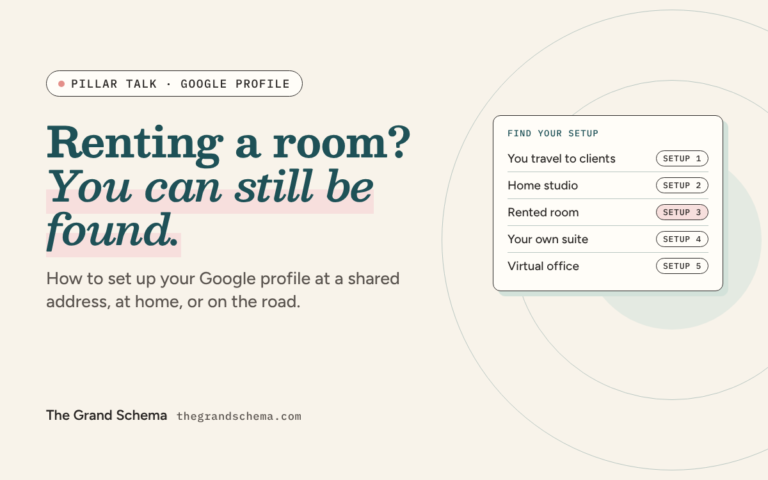
Yes, and it usually should be. Two businesses at one address with the same primary category are the classic setup for Google’s filter, which hides one of them for certain searches. A different, accurate category reduces that risk.
What if I practice several modalities but hold a license in only one?
Make the licensed work your primary category, since that’s the claim you can back. Add the other modalities as secondary categories where they exist, and as services where they don’t. Never choose a category that implies a license or title you don’t hold.
Keep reading
Sources
- Whitespark, Whitespark’s 2026 survey
- Google Business Profile Help, Google’s guidelines
- lobstr.io, Lobstr.io
- JAMA Network Open, via PubMed Central, A 2024 JAMA analysis
- Google Business Profile Help, Category-specific features
- Sterling Sky, A running log of category changes