Why Isn’t My Massage Business Showing Up on Google Maps? 12 Fixes for Wellness Practices
The short answer
When a massage or wellness practice doesn’t show up on Google Maps, the cause is almost always one of three things. The profile isn’t live: it’s unverified, suspended, or duplicated. Google can’t tell what you do: your category is too broad or your profile is thin. Or Google doesn’t trust you enough to rank you over a closer competitor: you have few recent reviews, details that don’t match, and nobody else mentioning you. You can’t change how far you are from the person searching. You can change almost everything else.
I spent twenty years on the treatment-room side of wellness before I started auditing practices’ search visibility. I’m a Kansas-licensed esthetician, trained in Vodder-method lymphatic drainage, and I’ve managed spas in three cities. I know what a quiet week costs when nobody can explain it.
This guide mirrors Ghosted, my free twelve-question visibility scorecard. Each fix answers one of its questions, grouped under the same four pillars: Findable, Readable, Credible, and Citable. For the local picture beyond Maps, see local SEO for a wellness practice.
The 12 fixes at a glance
| Fix | Pillar | Time | Effect |
|---|---|---|---|
| 1Find out if you’re missing, doubled, filtered, or buried | Findable | 15 min | Diagnostic |
| 2Set the most specific primary category | Findable | 10 min | Direct |
| 3Match name, address, phone, and hours everywhere | Findable | 1–3 hrs | Direct |
| 4Make your schema agree with your profile | Readable | 1–2 hrs | Supporting |
| 5Get services and classes out of the booking widget | Readable | An afternoon | Direct |
| 6Publish prices in text | Readable | 30 min | Conversion |
| 7List credentials with issuer and year | Credible | 1 hr | Supporting |
| 8Earn a steady stream of reviews | Credible | Ongoing | Direct |
| 9Get mentioned on sites you don’t own | Credible | Ongoing | Direct |
| 10Check what AI assistants say about you | Citable | 30 min a month | Diagnostic |
| 11Answer client questions in plain text | Citable | An afternoon | Supporting |
| 12Rewrite your homepage’s first paragraph | Citable | 1 hr | Direct |
How Google decides who shows up
Google says local results rest on three factors: relevance, meaning how well your profile matches the search; distance from the searcher; and prominence, meaning how well known your business is, which draws on signals like how many sites link to you and how many reviews you have.
Google doesn’t publish the weights. The closest thing is Whitespark’s Local Search Ranking Factors survey, where 47 local search experts score 187 factors. Here’s how the factors in this guide scored in the 2026 edition.
What 47 local search experts say moves the map pack
Maps impact score out of a possible 235, for the factors this guide covers. Each bar names the fix that works on it.
Almost everything near the top is Google Business Profile work. Schema markup and frequent Google posts, two things practitioners often pay for first, sit near the bottom.
Findable: can Google put you on the map?
Fix 1: Are you missing, doubled, filtered, or buried?
Ghosted asks where you land in the map pack. Before fixing anything, find out why you’re not there. Each answer needs a different fix.
- Search in a private windowOr use your phone near where your clients live. Your own search history skews the results, and so does searching from across town.
- Search the service and the townType what a client would, such as “lymphatic drainage massage Overland Park.” Don’t search your business name yet.
- Search during your business hoursIn Whitespark’s 2026 survey, being open at the time of the search ranked fifth for Maps. Founder Darren Shaw describes businesses slipping as closing time nears and dropping out once they close. A 10 p.m. check shows you a closed-hours result.
Then match what you found:
-
Missing
- You see
- Nothing, even when you search your exact business name.
- It means
- Your profile isn’t live.
- Next step
- Open your Business Profile dashboard and look for unverified, suspended, or under review.
-
Doubled
- You see
- Two listings for your practice.
- It means
- A duplicate is splitting your reviews and signals.
- Next step
- Keep the verified one and request removal of the other.
-
Filtered
- You see
- Another practitioner at your address shows up. You don’t.
- It means
- Google is showing one of you and hiding the other.
- Next step
- Read the guide for room renters.
-
Buried
- You see
- You appear for your name, but not for your service.
- It means
- Google knows you exist but ranks others first.
- Next step
- Fixes 2 to 12, starting with your category.
Google’s guidelines allow one profile per location, though individual practitioners may have their own. Businesses that serve clients at the client’s location should set a service area instead of a public address. Don’t open a second profile to get around a verification problem. It tends to make the problem worse.
If you’re home-based and clients never come to you, hide your address. Whitespark’s experts ranked a visible address seventh for Maps, but Shaw himself reports cases where hiding it didn’t move rankings, and he suspects a Google bug when it does. Either way, follow the guidelines.
Fix 2: Is your primary category too broad?
Primary category topped the 2026 survey, just ahead of distance. A practice set to “Spa” competes for spa searches, not massage searches. A category chosen at signup and never touched again is the local-search version of a voicemail greeting from 2019.
Local SEO firm Sterling Sky offers a test drawn from Google’s guidelines: pick the category that completes “this business IS a…,” not “this business HAS a….”
- Primary: the most specific category that describes your whole practice. That usually means “Massage therapist,” not “Spa” or “Wellness center.”
- Secondary: your other real modalities. Additional categories ranked eighth.
- Skip: any category for a service you offer twice a year.
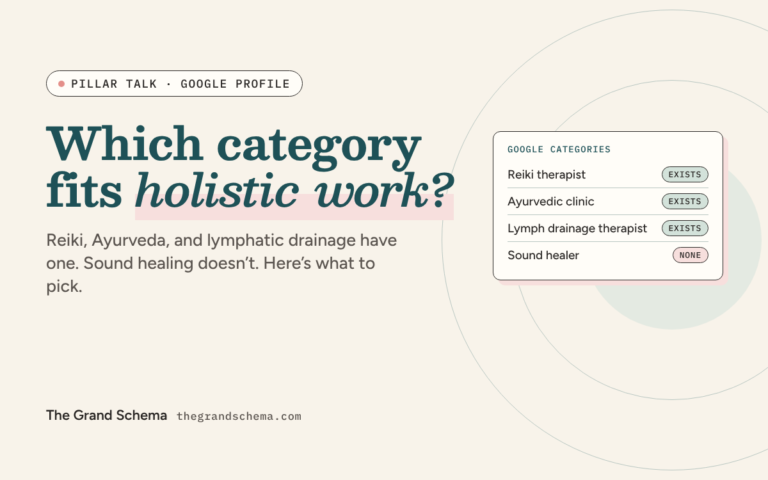
Change your category once, on purpose. Edits to core fields can send a profile back into review, and Google adds and retires categories, so the right one may not have existed when you signed up. The category guide for holistic practitioners covers sound healing, Reiki, Ayurveda, and lymphatic drainage.
Fix 3: Do your name, address, phone, and hours match everywhere?
A website name, address, and phone number that match the Google profile ranked 15th for Maps. Consistent listings across Google, Bing, and Apple Maps ranked 28th. Check character by character. “Suite 200” and “Ste 200” are different strings, and an old studio address on Yelp is a contradiction Google has to resolve without you.
Your name. Keywords in the business name ranked third for Maps. That’s exactly why Google suspends profiles that add unnecessary words to the business name.
Keep
- The name on your signage, license, and bank account
- “Massage” in the name, if it’s in your registered name
Suspension risk
- “Massage Overland Park” added to a name that doesn’t include it
- Service lists, slogans, or emoji in the name field
Your hours. List the hours you can actually be reached and booked, and nothing wider. If you work purely by appointment with no set schedule, Google’s guidelines say appointment-only businesses shouldn’t list hours at all, even though that costs you the open-at-search boost.
Where to check: Google Business Profile, Apple Business Connect, Bing Places, Yelp, your professional association directory, your booking-platform profile, and your Facebook page.
Readable: can a machine tell what you do?
Fix 4: Does your schema agree with your Google profile?
Schema markup is code that states your name, address, hours, and services in a format machines don’t have to interpret. I write schema for a living, so here’s the honest version: it isn’t a Maps ranking lever. Whitespark’s experts ranked schema-marked-up content near the bottom of all 187 Maps factors. Content agency Eleven’s 2026 research (I’ve written for Eleven) also found little evidence that adding schema raises AI citations, and Google says sites need no special structured data to appear in AI Overviews or AI Mode.
So why is it on this list? It removes ambiguity. When your markup, your website footer, and your Google profile all say the same thing, Google has one version of you instead of three. When they disagree, schema adds a fourth contradiction. Google’s AI features guide asks for the same thing: structured data that matches the visible text on the page, and Business Profile information that’s up to date.
- Use a LocalBusiness type, or a more specific one, with the exact name, address, phone, and hours from your profile.
- Validate it at validator.schema.org.
- Recheck after every theme or plugin update. Quietly broken markup is common.
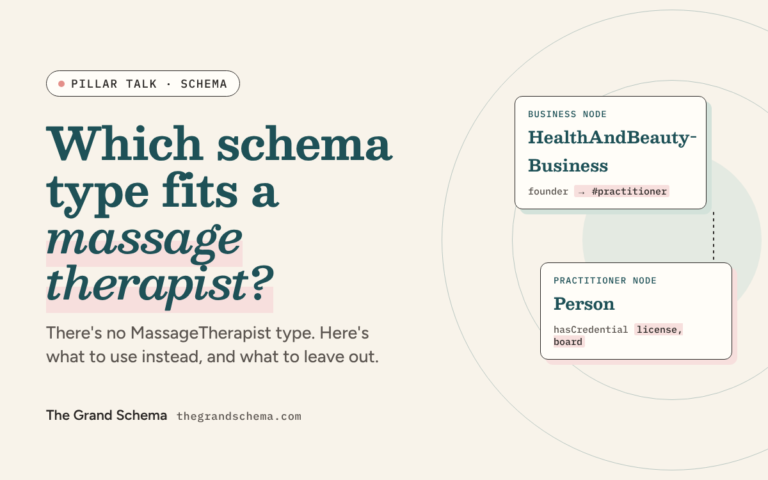
More detail: schema markup for wellness websites, and which schema type fits a massage therapist, esthetician, or acupuncturist.
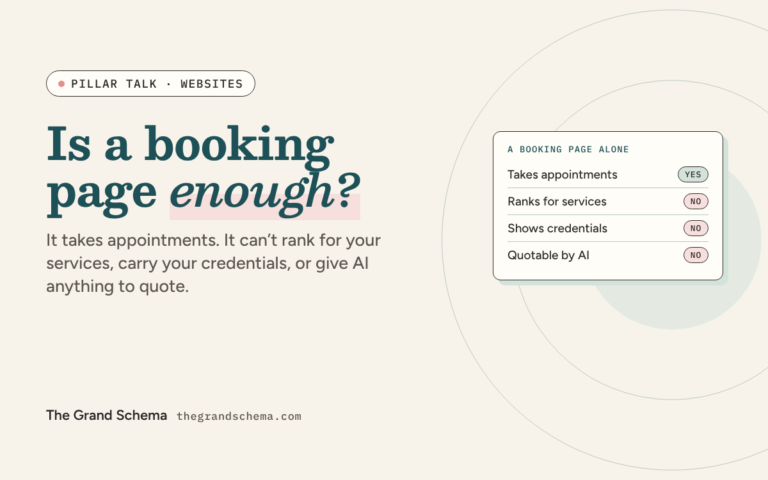
Fix 5: Are your services and classes trapped in a booking widget?
Your Google profile has a Services section most practitioners never fill in. Predefined services ranked 22nd for Maps, and Whitespark’s founder says his own testing confirmed that services affect rankings. Add every suggested service you actually offer, then create custom ones for the rest.
On your website, check where your service list lives. A Vercel and MERJ analysis of crawler traffic found that none of the major AI crawlers from OpenAI, Anthropic, Meta, ByteDance, or Perplexity run JavaScript. Google’s Gemini uses Googlebot’s rendering, so it can.
One services page, two readers
A service menu that loads inside a booking widget, as each kind of crawler receives it.
- Swedish massage, 60 min$95
- Manual lymphatic drainage, 60 min$120
- Prenatal massage, 60 min$105
<div id="booking-widget"></div>
No services, no prices. Nothing here to quote.
Google can usually read your Vagaro or Mindbody embed. ChatGPT probably can’t. Put each service on your own page as plain text: its name, length, what it’s for, and its price. Classes also need a date and time. A dedicated page for each service is the number one local organic factor in the same survey.
Fix 6: Can someone find your prices without asking?
Price isn’t a documented Maps ranking factor. It’s here because of what happens after someone finds you. They compare three practices, and the one with a visible price gets the click. Google’s AI answers now build responses from your profile and website, as Fix 11 explains. If your price isn’t there, the answer can’t include it.
- Add prices to your Google services list.
- Put them on your site as text, not in a PDF or an image.
- Ranges are fine: “from $95 for 60 minutes.”
Credible: does Google trust you enough to rank you?
Fix 7: Do your credentials name the issuer and the year?
Wellness falls under what Google calls Your Money or Your Life: topics where bad information can hurt someone. Google’s own guidance calls trust the most important part of E-E-A-T, and says its systems give even more weight to strong E-E-A-T on topics that could affect people’s health.
A credential without its issuer is an assertion. Compare:
Assertion
LMT, certified in lymphatic drainage.
Evidence
Licensed massage therapist, [state board], license #[number], since [year]. Vodder-method manual lymphatic drainage, [school], [year].
My About page lists my Kansas esthetician license with its number and a link to the Kansas Board of Cosmetology’s public lookup. Anyone can verify it in thirty seconds. That’s the point.
The same guidance asks whether bylines lead to more information about the author, and names an author page or a site’s About page as ways to show that background. For a solo practice, your About page works, as long as it’s about you and not just the business. Some state boards regulate how license numbers appear in advertising, so check yours.
Credentials aren’t a direct Maps factor. They matter to the person comparing you with the practice down the street, and to AI tools deciding whom to name.
Fix 8: How many reviews did you get this year?
Google says more reviews and positive ratings can help your local ranking. Whitespark’s experts ranked Google rating sixth, the number of Google reviews with text ninth, review recency 11th, and a steady flow over time 14th. Recency beats a pile of reviews from 2021.
Research outside SEO agrees. Harvard Business School’s Michael Luca found that a one-star Yelp increase raised restaurant revenue 5 to 9 percent, with the effect driven by independent businesses rather than chains. That study covered restaurants, but a solo practice is as independent as it gets. In healthcare, a 2014 JAMA study found 59 percent of patients consider a physician’s online rating somewhat or very important when choosing one.
How to ask without breaking the rules:
Do
- Ask every client, within a day of the session
- Send a direct link with the same neutral wording for everyone
- Reply to every review, briefly
Don’t
- Ask only the clients you think loved it
- Offer a discount, a freebie, or a prize drawing
- Ask them to mention a service, a town, or your name
Google’s review policy prohibits incentives, discouraging negative reviews, selectively soliciting positive ones, and requesting specific content. An April 17, 2026 update added explicit bans on requesting reviews that contain specific content, including naming a staff member. The FTC’s rule separately bans fake reviews and incentives tied to positive or negative sentiment.
When you reply, never confirm someone was a client or refer to their session. HHS has settled with both a dental practice and a psychiatric practice, the latter for $30,000, over health details disclosed in replies to online reviews. HIPAA may not cover a cash-pay massage practice, but client confidentiality still does.
Thank you for taking the time to write this.
We take every review seriously. Please call us at [number] so we can talk.
Fix 9: Do sites you don’t own mention your practice?
Whitespark found that three of the top five AI search visibility factors are citation factors, meaning listings and mentions of your business on other sites. Shaw recommends industry directories, expert “best of” lists, writing for local papers, and working with local bloggers. Eleven’s research likewise found that outside mentions and referring domains predict AI citations. It also warns against manufacturing Reddit mentions: Reddit’s share of ChatGPT Search citations collapsed within a single day in August 2026.
Where to start:
- Your association’s member directory. AMTA and ABMP both run one.
- The practitioners you refer clients to, such as chiropractors, acupuncturists, and doulas.
- Local wellness collectives, your chamber of commerce, and neighborhood newsletters.
- Podcasts that interview practitioners.
Check your footprint: search -site:yourdomain.com "Your Name" to see where you appear outside your own site.
Citable: will an AI assistant recommend you?
Maps and AI answers don’t reward the same things. Whitespark’s 2026 survey scored every factor twice, once for Maps and once for AI search, and some factors trade places.
Maps and AI answers reward different things
Rank out of 187 factors. Further left is stronger.
Google Maps rankAI search rank
- Open at the time of searchMaps 5th, AI 104th
- Address showing on the profileMaps 7th, AI 54th
- Google’s predefined servicesMaps 22nd, AI 127th
- Fresh content on the linked pageMaps 83rd, AI 77th
- FAQs on the page your profile links toMaps 135th, AI 55th
- Website content marked up with schemaMaps 162nd, AI 44th
- Scannable headings and lists sitewideMaps 128th, AI 10th
Being open when someone searches, showing an address, and filling in Google’s service list matter far more for Maps. Scannable headings, FAQs, and schema matter far more for AI answers. Fixes 10 to 12 work the AI side.
Fix 10: What does an AI assistant say when asked for your service in your town?
Ghosted calls this its most revealing question. Here’s how to answer it properly:
- Ask four assistantsChatGPT, Gemini, Perplexity, and Google’s AI Mode: “Who offers [your service] near [your town]?”
- Log out firstUse a logged-out or private session so your own history doesn’t steer the answer.
- Run each query three timesOne run proves nothing. A 2026 study of Perplexity, OpenAI’s search, and Gemini found identical queries returned different citations over time.
- Write it downThe date, the assistant, and every practice named. A monthly log is your real scoreboard.
Keep perspective. Shaw notes that people still find local businesses mainly through Google’s local results, and that Google’s AI Mode can use profile data like your categories while ChatGPT likely can’t. Get Maps right first. For a worked example, here’s a real log from a Kansas City–area practice.
A real log: Prairie Village, September 24 to 26, 2026
For the Wild Yonder Wellness case study, I ran 25 logged-out prompts across ChatGPT, Perplexity, Google’s AI Mode, and AI Overviews, with a dated screenshot of each. ChatGPT, Perplexity, and AI Mode all named Wild Yonder first for “best massage therapist in Prairie Village.” Across all 25 prompts, it was named in 8. It disappeared for deep tissue, prenatal, and craniosacral questions, and the assistants repeated outdated details, including a service the studio doesn’t offer.
The useful pattern: ChatGPT answered from the Google listing, and Perplexity answered from the website. Fixing one moves one assistant, not both. (Disclosure: the owner is my brother-in-law.)
Fix 11: Are your answers to client questions visible as text?
Google shut down the Business Profile Q&A API on November 3, 2025, and the Q&A section has been disappearing from profiles since. Its replacement, Ask Maps, is a Gemini feature that builds answers from your profile, reviews, photos, and website. You can no longer write the answer on Google. You can write it on your site.
Answer the six to ten questions clients ask before booking:
- What should I wear?
- How long is a session, and what happens in the first one?
- What does it cost?
- Who is this not right for, and when should I check with my doctor first?
- What’s the cancellation policy?
- Is there parking? Is the space accessible?
Click-to-expand accordions are fine if the answer text is in the page’s HTML. The risk is text that loads by JavaScript only when clicked, or answers that live only in a PDF, an image, or a video.
Check it in thirty seconds: open your FAQ page, press Ctrl+U on Windows or Option+Command+U in Chrome on a Mac to view the source, then search for one sentence from an answer. If it isn’t there, most AI crawlers can’t see it.
Specifics help. The KDD 2024 GEO study led by Princeton researchers found that adding statistics, source citations, and quotations can raise a page’s visibility in AI-generated answers by up to 40 percent. For a practitioner, that means real session lengths, real prices, and a plain description of what happens in the first ten minutes.
Fix 12: Does your homepage’s first paragraph say what, where, and for whom?
The page linked from your Google profile carries more weight than any other page you own. For that page, keywords in the title tag ranked 17th for Maps, city and neighborhood relevance ranked 18th, and keywords in headings ranked 20th.
One homepage opening, rewritten
Before
Welcome to a sanctuary for body, mind, and spirit.
Lovely to read. Tells a stranger and a machine nothing.
After
[Practice name] is a licensed massage therapy practice in [town], [state], offering lymphatic drainage, prenatal, and deep tissue massage for adults across [county or metro].
Title tag pattern: [Service] in [Town], [State] | [Practice name]
Put the answer first, for readers and for machines. Stanford-led research found that language models use information at the start or end of a long input far more reliably than information in the middle. That study tested long documents, not homepages, but the lesson carries over: don’t bury what you do under a mission statement.
The one factor you can’t fix: distance
Distance from the searcher ranked a close second to primary category. If a searcher doesn’t share their location, Google uses what it knows about where they are.
A practice in Overland Park won’t win “massage near me” typed in Lee’s Summit, and nothing above changes that. A bigger service area won’t extend your reach either: experts flagged service areas beyond two hours’ drive as a suspension risk. Aim to be the strongest option within the radius you actually serve.
Where to start
If you have one hour, do fixes 1 and 2, then start Fix 3 with your Google profile and your own website. In your next session, finish Fix 3 across the other listings and rewrite your first paragraph for Fix 12. Everything else sorts like this:
Effort against effect on Maps
Frequently asked questions
Why did my business suddenly disappear from Google Maps?
Check four things in order. Is the profile suspended or under review? Are you searching outside your business hours? Has a duplicate listing appeared? Has a competitor opened closer to where you’re searching? A disappearance right after you edit your name, category, or address usually means Google is re-reviewing the profile.
Can a home-based or mobile massage therapist show up on Google Maps?
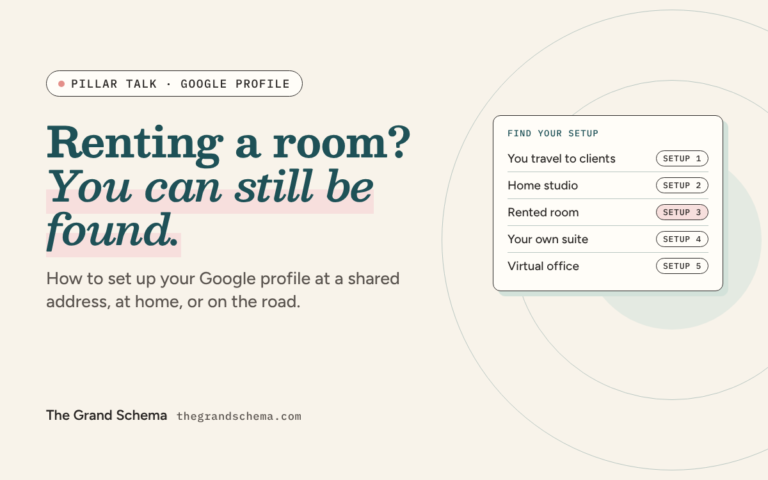
Yes. If you travel to clients, set a service area and hide your address. If clients come to your home, Google expects the address to be shown and asks businesses that display an address to keep permanent signage there. Therapists who rent a room inside another practice have their own set of rules.
Do Google Business Profile posts help my ranking?
Not much. Frequency of Google posts ranked 148th of 187 Maps factors in Whitespark’s 2026 survey. Posts can help someone choose you once they’ve found you. Spend your ranking time on fixes 2, 3, and 8 first.
Should I add “massage” or my city to my business name on Google?
Only if it’s part of your real, registered name. Keywords in a business name do help rankings, which is exactly why Google suspends profiles that add them.
Do I need a website to show up on Google Maps?
No. A verified profile can appear without one. But the page your profile links to feeds several ranking factors, and it’s where AI answers look for your prices and policies.
Keep reading
Sources
- Google Business Profile Help: Tips to improve your local ranking and Guidelines for representing your business
- Google Search Central: Creating helpful, reliable, people-first content and AI features and your website
- Google Maps: Prohibited and restricted content policy
- Whitespark, 2026 Local Search Ranking Factors
- Schema.org, Schema Markup Validator
- Sterling Sky, Guidelines for representing your business on Google
- BrightLocal, A guide to Google Business Profile Q&A
- Eleven, 7 AI search tactics that aren’t worth the budget. Disclosure: the author has written for Eleven.
- Vercel and MERJ, The rise of the AI crawler
- Luca, M. Reviews, Reputation, and Revenue: The Case of Yelp.com. Harvard Business School working paper.
- Hanauer, D.A., et al. (2014). Public awareness, perception, and use of online physician rating sites. JAMA.
- Aggarwal, P., et al. (2024). GEO: Generative Engine Optimization. KDD 2024.
- Liu, N.F., et al. (2024). Lost in the Middle: How Language Models Use Long Contexts. TACL.
- Federal Trade Commission, Final rule banning fake reviews and testimonials (2024)
- Nixon Peabody, HIPAA-regulated entities must use caution responding to online reviews (2023)